

Sample: What RAM-only servers actually mean for your privacy
Every VPN says it keeps no logs. Only some of them have built infrastructure where keeping logs would be impossible. Here is the difference, and how to tell which one you are looking at.

A no-logs policy is a promise about behaviour. RAM-only infrastructure is a fact about hardware. The second one is much harder to break, and it is the thing worth checking before you hand a company your traffic.
What a conventional VPN server keeps
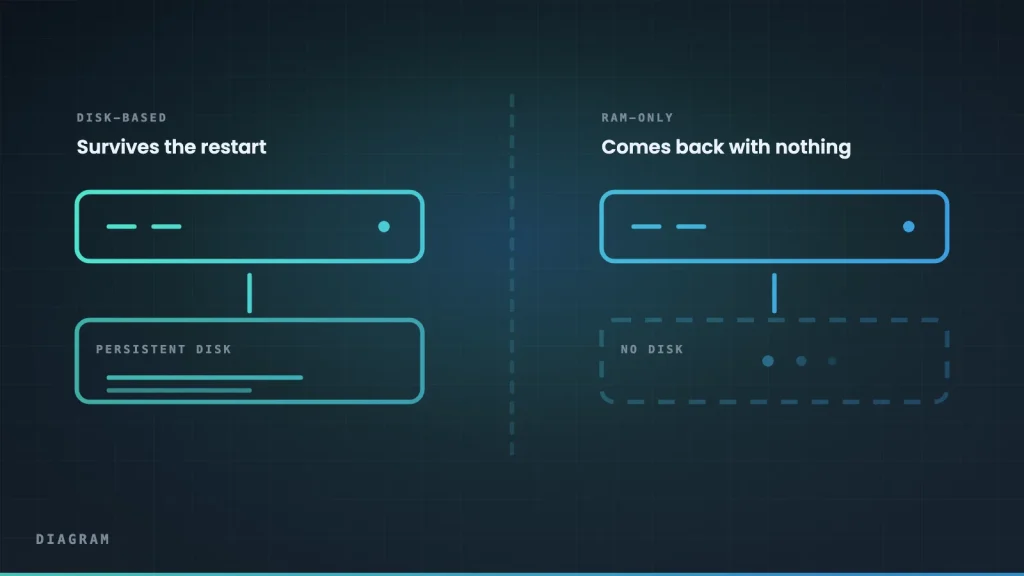
A normal server has a hard disk. The operating system writes to it constantly — system logs, crash dumps, connection state, caches — because that is what operating systems do. Even a provider genuinely trying to keep nothing has to actively suppress all of that, on every machine, forever, and hope no configuration drifts.
That is a real operational burden, and it is invisible to you. You cannot audit a promise. What you can reason about is whether the storage exists at all.
What RAM-only actually means
A RAM-only server has no persistent disk. The whole operating system is loaded into memory at boot from a signed image, runs entirely from there, and vanishes the moment power is cut. There is nowhere to write, so nothing is written.
- No system logs survive a restart, because there is no filesystem for them to survive on.
- No connection records accumulate, because there is nowhere for them to accumulate.
- Reboot the machine and it comes back byte-identical to the image it was built from.
The question is not “do you keep logs?” It is “could you, if someone made you?”
Why the seizure case matters
The scenario privacy people worry about is not a company deciding to sell data. It is a server being physically taken, or a legal order arriving for whatever is on it. With a disk-based server, that question has an answer that depends on configuration and good intentions. With a RAM-only server, unplugging it to take it away is what erases it.
How to check a provider’s claim
Marketing pages are not evidence. Three things are worth looking for, in ascending order of how much they tell you:
- A specific architectural claim, not an adjective. “RAM-only, diskless servers” is checkable. “Military-grade security” is not a claim about anything.
- A published no-logs audit by a named third party, with a date and a link to the actual report — including whatever the auditor did not like.
- A transparency report showing how many legal requests arrived and what was handed over. On a genuinely diskless network the last column should read nothing, every time.
What it does not solve
RAM-only architecture protects what is stored on the server. It does nothing about what you hand over elsewhere: the email you signed up with, the card you paid with, or the account you are signed into while browsing. Those are account-hygiene problems and no infrastructure decision fixes them.
It also does not, on its own, prove a provider is honest. It makes dishonesty much harder to hide, which is a different and more useful property. Pair it with an independent audit and you have something closer to evidence.
How CopVPN does it
All CopVPN servers run RAM-only, in 65+ countries and 85+ locations. The reasoning behind that and the rest of our architecture is on why CopVPN.
The short version
Ask what a provider’s servers are physically capable of storing, not what its policy says it chooses to store. The first question has a checkable answer. The second one is a sentence anyone can write, and most of them have.
Sample author. Writes about network security and privacy for CopVPN. Mostly interested in the gap between what security products claim and what they can be shown to do.